A curated collection of articles, insights, and thought-provoking excerpts exploring fertility, demographics, family, public policy, and the forces shaping societies and their future.
Income levels, job security and economic uncertainty, influence family size, decisions
Rising education, especially among women, is strongly linked to lower fertility rates.
Taxes, benefits, housing and family policies can either support or suppress fertility.
Urbanization provides health, family planning and lifestyle options, contributing to lower fertility rates.
The average number of children needed per woman in the west to maintain a society whose population doesn’t decline. The number, known as the replacement-level fertility rate, exceeds 2 because more boys than girls — 105 vs 100 — are born, and because some girls die young, without having children. In countries with high infant mortality, the replacement-level fertility rate exceeds 3.0.
For a society to reach the 2.1 average fertility rate needed to reach sustainability, 35% of women will need to have three or more children to compensate for those who have fewer than two, whether because of personal choice or infertility.
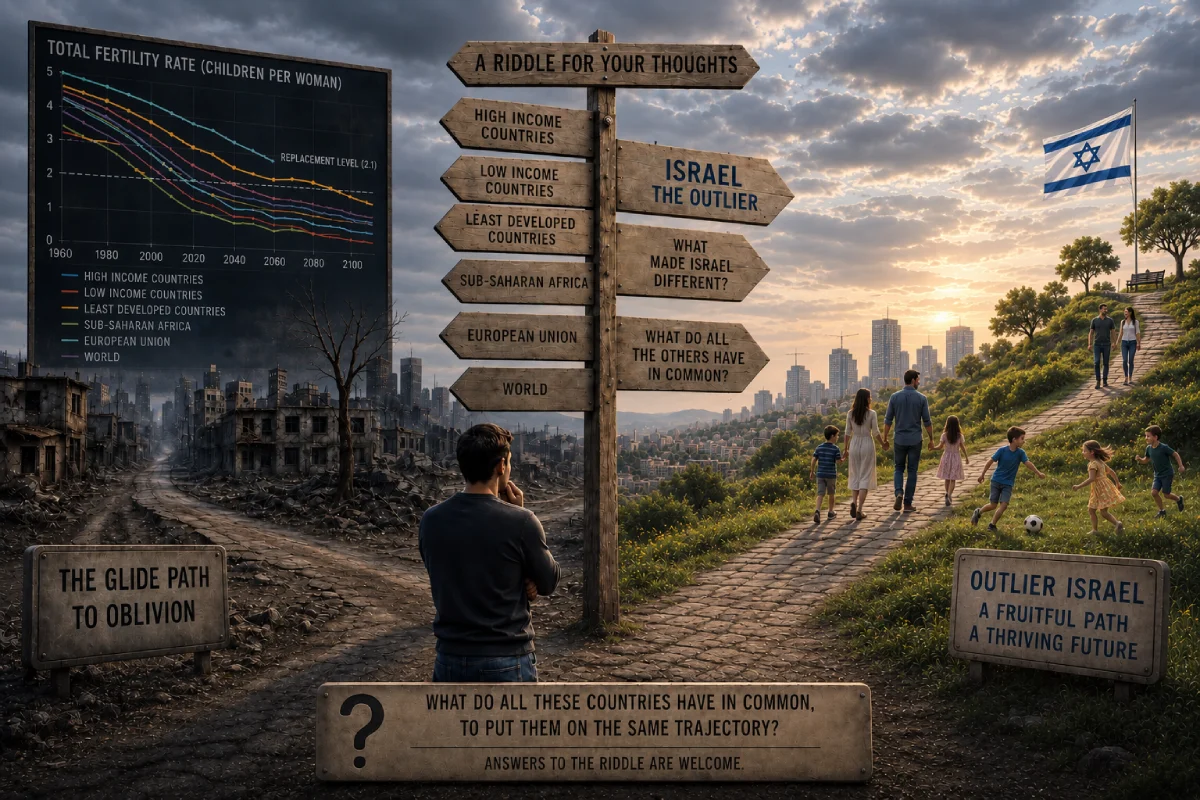
The number of affluent countries that have stable or growing fertility rates. That sole country is Israel, whose overall fertility rate is 3, almost twice that of western countries. Jews in Israel, whether secular or religious, meet or exceed the 2.1 figure. Israel’s large Muslim population (21% of the total) also has a relatively high fertility rate, unlike Israel’s small but affluent Christian population, whose fertility more resembles that of Europe.
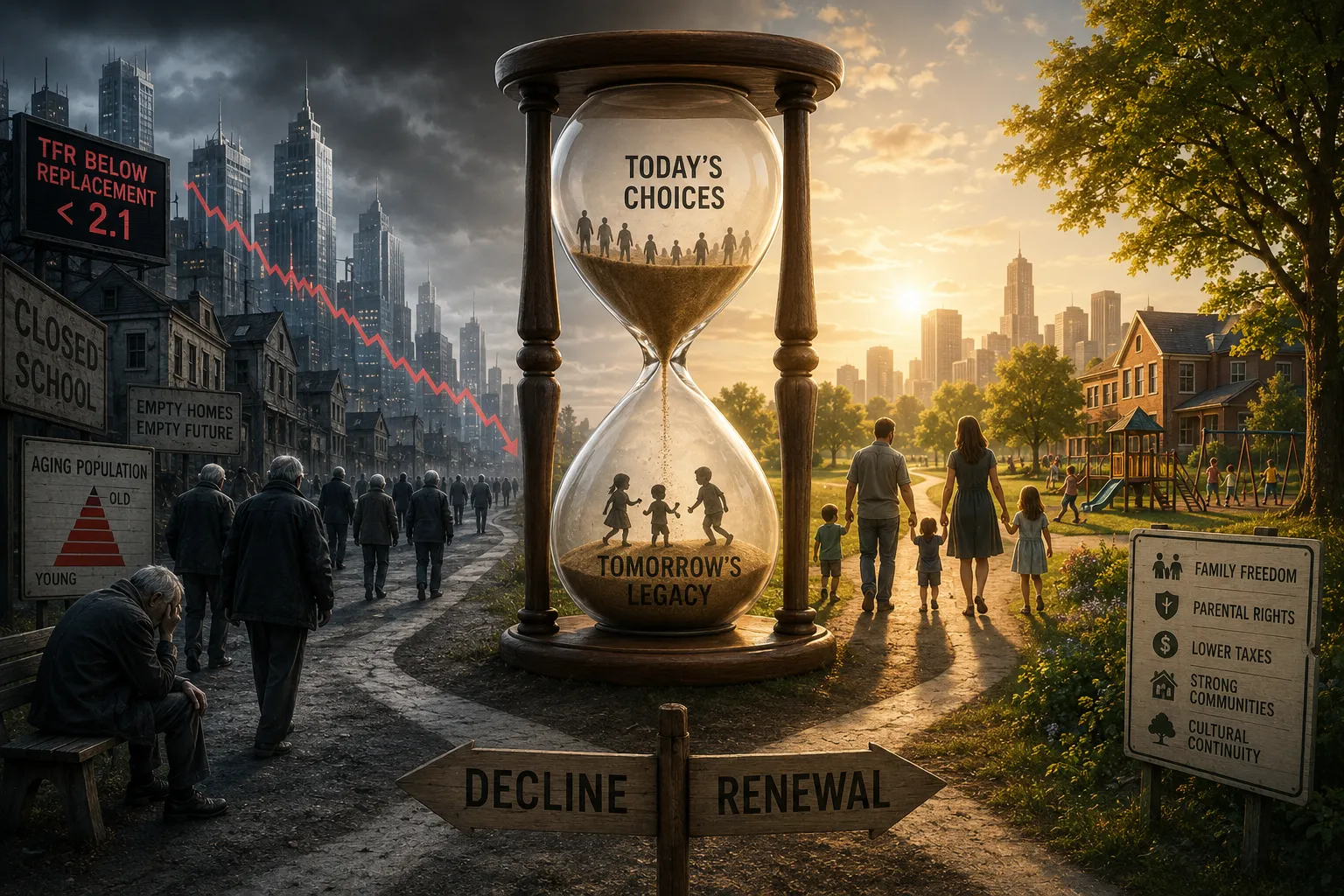
No foreign policy actions can save a civilization if its population keeps dropping. Population collapse of Romans over time is what caused Rome to fall. The Romans worried about this, but failed to stop it.

For decades, the dominant culture said that having a child was likely to be incompatible with many other choices; that having a child compromised your freedom, your career, your dreams and in some cases even your beauty; a choice that basically took something away from you or risked taking away much more than it would give you.

Prime Minister of Italy
The great defining event of the twenty-first century—one of the great defining events in human history—will occur in three decades, give or take, when the global population starts to decline. Once that decline begins, it will never end. We do not face the challenge of a population bomb but of a population bust—a relentless, generation-after-generation culling of the human herd. Nothing like this has ever happened before.

Authors & Analysts
How Mankind Chose Extinction will be an interesting read if anyone is left to write it. … A sub-2.1 global TFR is a more powerful historical force than even the fecund Mr. Musk. It is coming. And there is nothing we can do to stop it.

Historian
The ultimate measure of human success is not production but reproduction. Economic productivity and profit are means to reproductive ends, not ends in themselves.

Sociologist and Anthropologist